

In the first episode of the Asheville Field Guide, I introduced a simple idea: every place has layers. In the second episode, I shared my story so that readers and listeners of AVL Sherpa would understand why I chose to embark upon this Substack project. In that second installment, I talked a lot about the importance of perspective. In this, the third episode, those two themes converge into a meta system for exploring not just Asheville but any place you choose to visit in the future.
If you enjoy this podcast, please share it with your friends and consider becoming a free or paid subscriber. You will find AVL Sherpa on Facebook, Instagram and YouTube. Thank you.
A Layered Approach to Exploring
When most people visit Asheville, they experience only a thin slice of what the region has to offer. They might take a scenic drive on the Blue Ridge Parkway, stop at a few breweries downtown, hike a popular waterfall trail, and call it a day. Those are wonderful experiences, but they represent only a small portion of what makes this place so fascinating.
What if we could explore Asheville more intentionally?
What if we could move beyond the obvious attractions and begin to see the deeper forces and events that shape the place itself?
Over time I began to realize that meaningful exploration follows a pattern. The more I traveled, hiked, studied local history, and paid attention to how places reveal themselves, the more I noticed that discovery tends to unfold in stages. I also realized that understanding a place becomes easier when we organize what we’re seeing into a simple framework.
That realization eventually led to what I now call the Asheville Field Guide.
Think of it as a system designed to help us explore places with greater awareness and curiosity. Instead of rushing from one attraction to another, the Field Guide encourages us to slow down, look deeper, and connect the dots between the many elements that shape a community.
The system is built around three simple visual ideas. One explains the journey of exploration. One explains the framework that supports that journey. And the third reveals the dimensions that make a place unique.
Let’s start with the journey itself.
The Sherpa Path
Exploration rarely happens all at once. It unfolds gradually, much like a trail winding through the mountains. Each step leads naturally to the next, and the deeper we go, the richer the experience becomes.
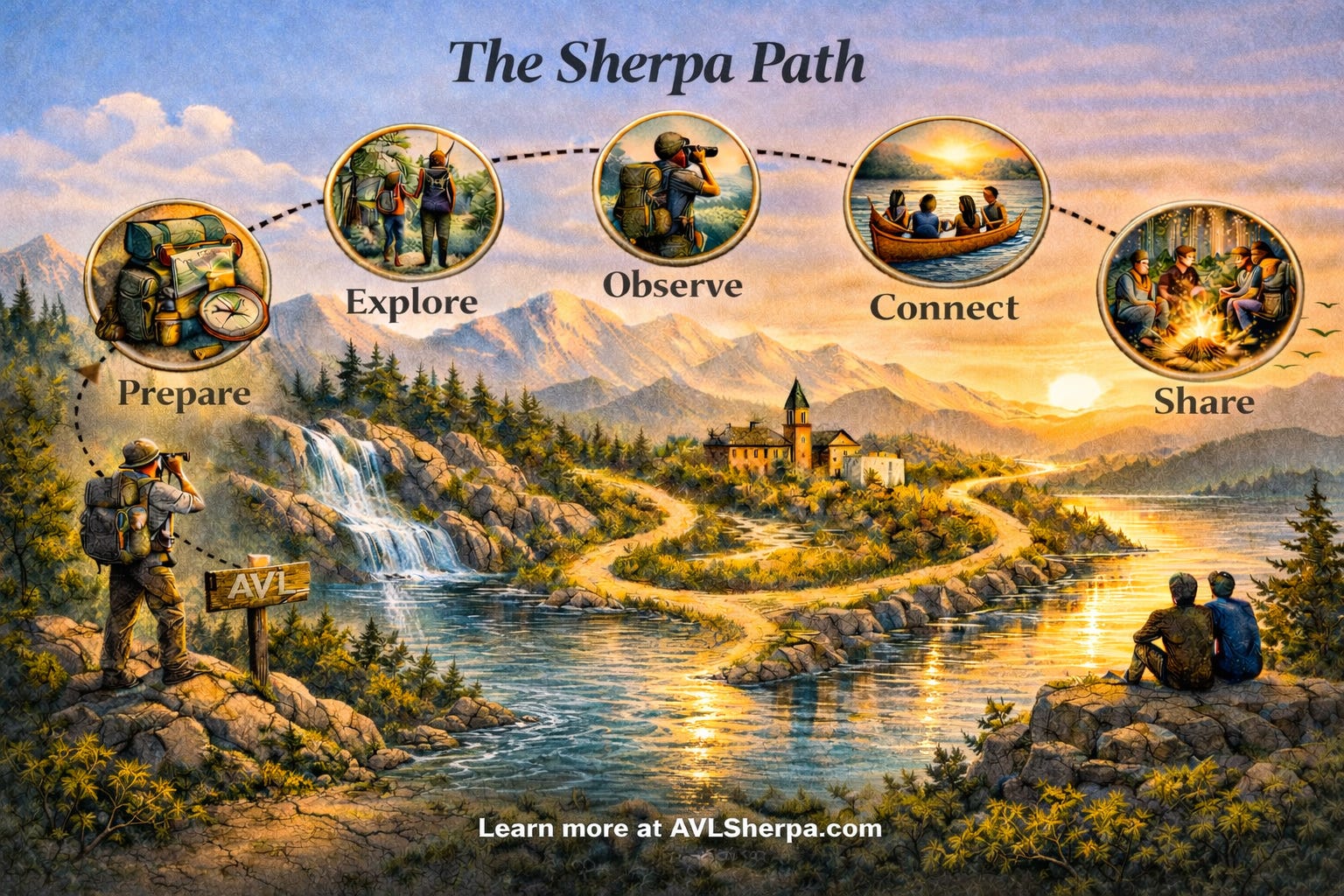
I call this process The Sherpa Path.
The name comes from the legendary mountain guides of the Himalayas. Sherpas are known for helping climbers navigate some of the most difficult terrain on Earth. But their role goes far beyond simply leading the way. A good Sherpa helps travelers understand the landscape, pace the journey, and notice the details that might otherwise go unseen.
Exploring a place works in much the same way.
The Sherpa Path describes five stages that naturally unfold as we engage with a place more deeply:
Prepare → Explore → Observe → Connect → Share
Preparation is the beginning of every meaningful journey. Before stepping onto the trail, we gather the tools, knowledge, and mindset that allow us to explore effectively. Preparation isn’t just about logistics. It’s also about approaching a place with curiosity and openness.
Once we step outside our routine, exploration begins. We wander through unfamiliar neighborhoods, follow trails into the mountains, and allow ourselves to be surprised by what we encounter. Exploration requires movement, curiosity, and a willingness to venture beyond the obvious.
Observation deepens the experience. Instead of simply moving through a place, we begin to notice details. The shape of a ridge line. The architecture of an old building. The atmosphere of a neighborhood café. Observation slows us down and turns exploration into awareness.
Eventually we begin to connect the pieces together. Geography influences history. Culture shapes food. Architecture reflects the character of a community. At this stage exploration becomes personal, and we begin to understand how the different parts of a place relate to one another.
Finally, the journey leads to sharing. Stories, photographs, and recommendations allow us to pass what we’ve learned to others. Sharing not only reinforces our own understanding, it inspires new journeys for those who follow.
The Sherpa Path describes how exploration unfolds. But understanding the journey is only the beginning. To truly explore a place with depth, we also need a framework that helps guide how we approach the experience.
The Blueprint
If the Sherpa Path defines the journey of exploration, the Asheville Field Guide Blueprint explains the framework that supports that journey.
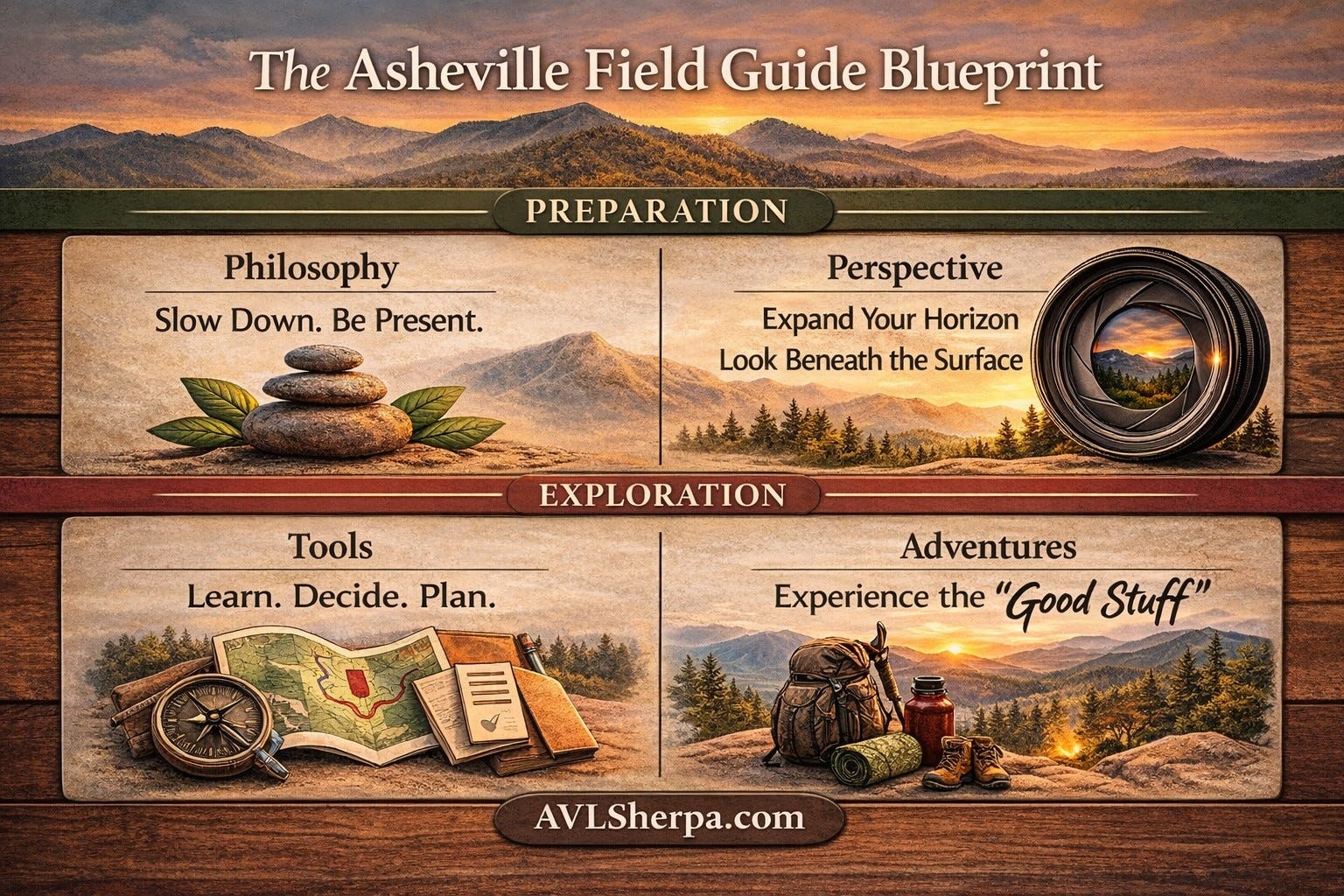
The Blueprint organizes the exploration process into two major phases: Preparation and Exploration. Each phase contains two key elements that guide how we approach a place.
Preparation establishes the mental and intellectual foundation for exploration. It consists of two elements: philosophy and perspective. Philosophy shapes the mindset we bring to a place, while perspective expands the lens through which we see it.
The philosophy of the Asheville Field Guide is simple but powerful:
Slow Down. Be Present.
Modern travel often encourages speed. We try to see as much as possible in the shortest amount of time. But the most memorable experiences usually happen when we slow down long enough to notice what’s around us. Being present allows us to engage more fully with the environment and the people we encounter along the way.
Perspective encourages us to widen the way we look at a place. Most visitors experience Asheville through a narrow set of attractions—restaurants, breweries, and scenic drives. While those experiences are wonderful, they represent only a small portion of the region’s story.
Perspective invites us to expand our horizon and look beneath the surface.
Once preparation is complete, exploration moves into action. This phase includes two elements: tools and adventures.
Tools help us learn about a place and plan our experiences. The Field Guide provides resources that allow us to learn about the region, decide which experiences resonate with us, and plan adventures that match our interests.
Adventures are where exploration becomes real.
The goal is simple:
Experience the good stuff.
That might mean hiking a trail at sunrise, discovering a hidden café tucked into a quiet neighborhood, listening to live music, or meeting someone whose story reveals something new about the community.
Preparation shapes how meaningful and memorable the exploration ultimately becomes.
But to fully appreciate that depth, it helps to understand the many forces and events that shape a place.
The Exploration Map
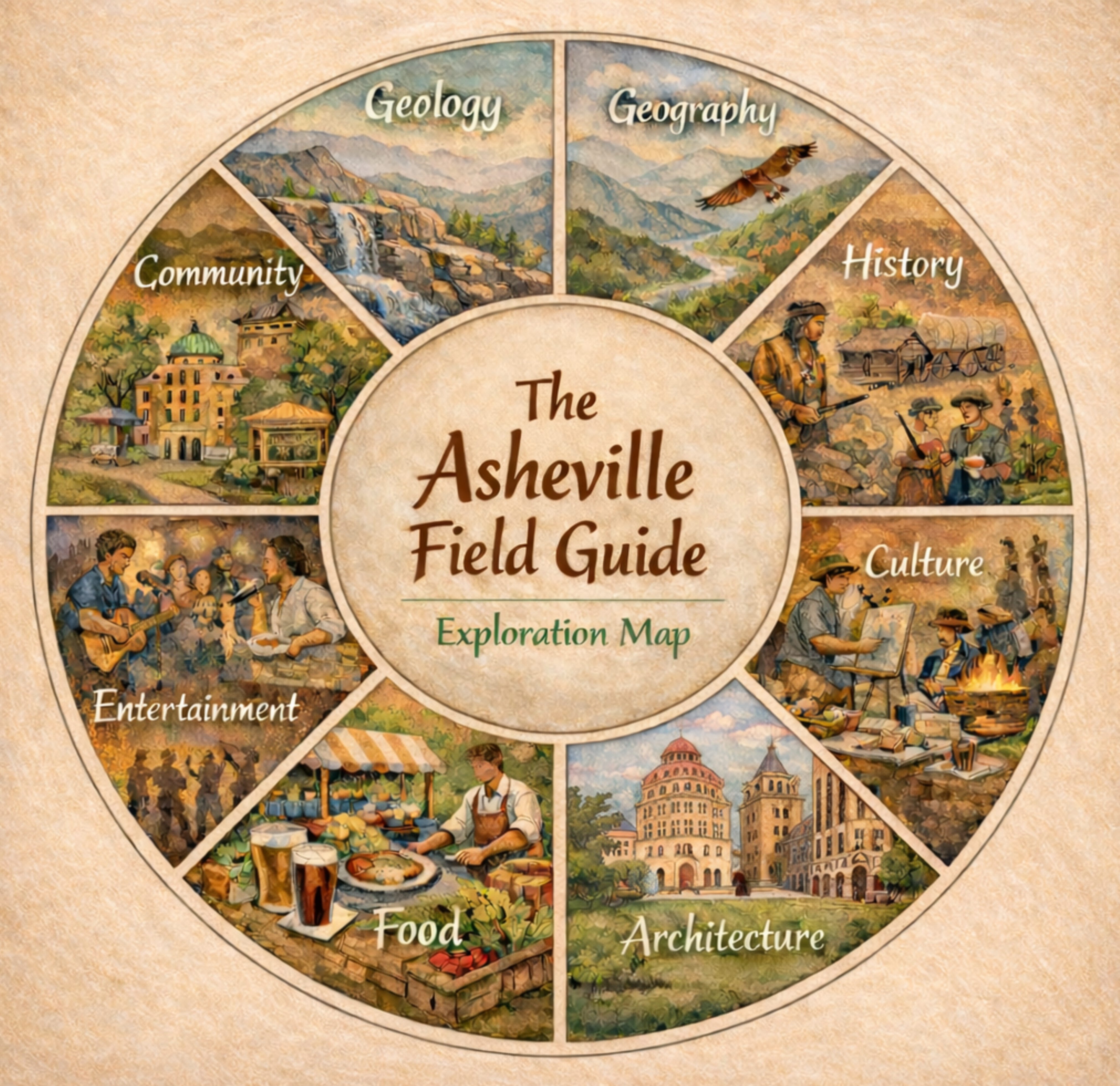
While the Sherpa Path defines the journey and the Blueprint explains the method, the Exploration Map reveals the deeper layers of place itself.
But this map works a little differently from the maps we usually use.
Most maps tell us where to go.
This map helps us see what to explore.
You might think of it as a kind of portal or window that expands our perspective and reveals the layers that make a place unique.
In some ways it works like a kaleidoscope.
Each turn of a kaleidoscope reveals a new pattern formed from the same pieces. The elements remain the same, but the relationships between them shift and change. Cities work the same way. A place reveals itself differently depending on the lens through which we look.
The Exploration Map organizes Asheville into eight dimensions that shape the identity of the region: Geology + Geography + History + Culture + Architecture + Food + Entertainment + Community
Everything begins with geology. The ancient mountains of Western North Carolina form the physical foundation of the landscape.
Geography builds on that foundation by shaping the rivers, valleys, and ecosystems that influence how people live and move through the region.
History tells the story of the people who have lived here over time, while culture reveals the creativity and traditions that define the community today.
Architecture shows how the built environment evolved, reflecting different eras and design influences.
Food tells a story about regional agriculture and culinary creativity, while entertainment captures the lively energy of the city’s music venues, festivals, and social spaces.
Finally, community ties everything together. The people who live here form the social fabric that gives Asheville its character.
No single dimension defines a place.
But together they create a rich and fascinating portrait of the region.
The Meta-System
When these three elements come together, they form a meta system* for exploring a place with depth and intention.
The Sherpa Path describes the journey of exploration.
The Field Guide Blueprint explains the framework that supports that journey, organizing the process into preparation and action so that experiences become both purposeful and meaningful.
And the Exploration Map reveals the many dimensions that make a place unique.
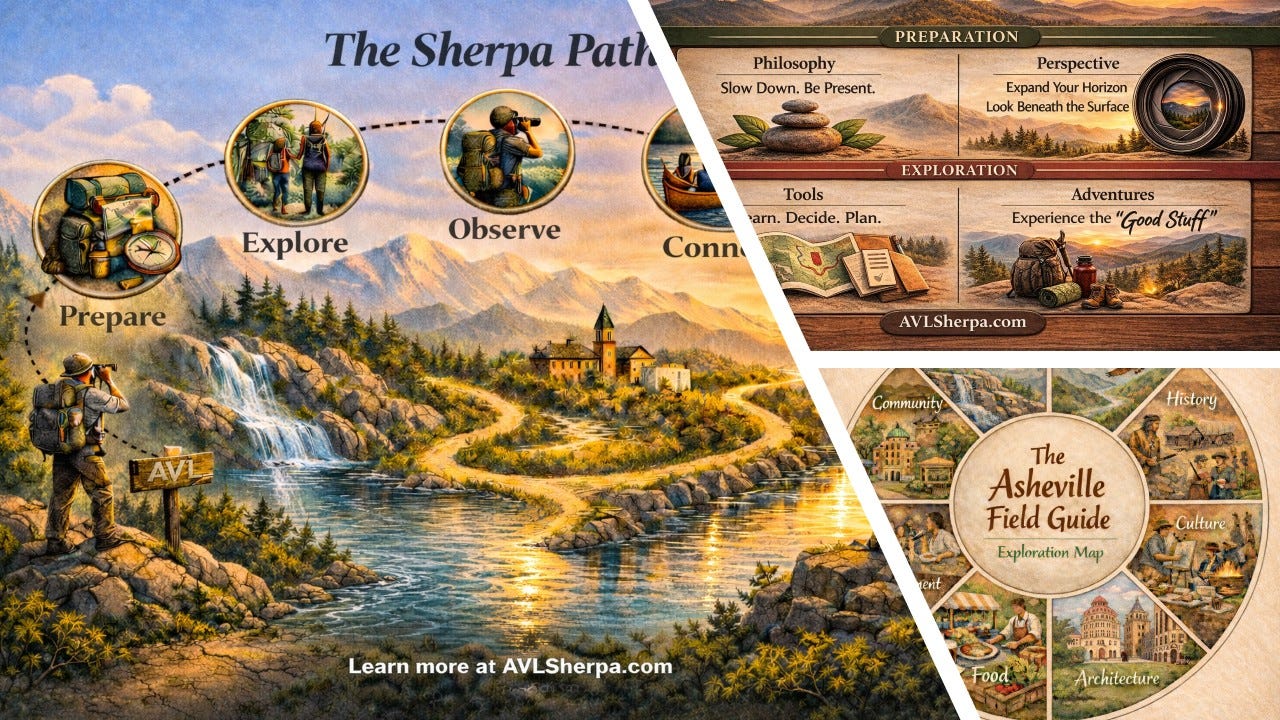
Together they transform travel from simple sightseeing into something richer: a deeper experience of discovery.
Instead of rushing from one attraction to another, we slow down. We observe. We connect the dots.
Gradually the place begins to reveal itself in ways we might never have noticed before.
And that’s when exploration becomes truly rewarding.
Next Up
In the next episode of the Asheville Field Guide, we’ll begin turning this framework into action as we explore the first of Asheville’s eight dimensions —
— GEOLOGY
Because once you start looking at a place this way, you quickly discover something surprising.
There is always more to see.
And that’s where the adventure really begins.
Thanks for tuning in. I appreciate your support and look forward to getting your feedback and suggestions.
Steve, your AVL Sherpa


